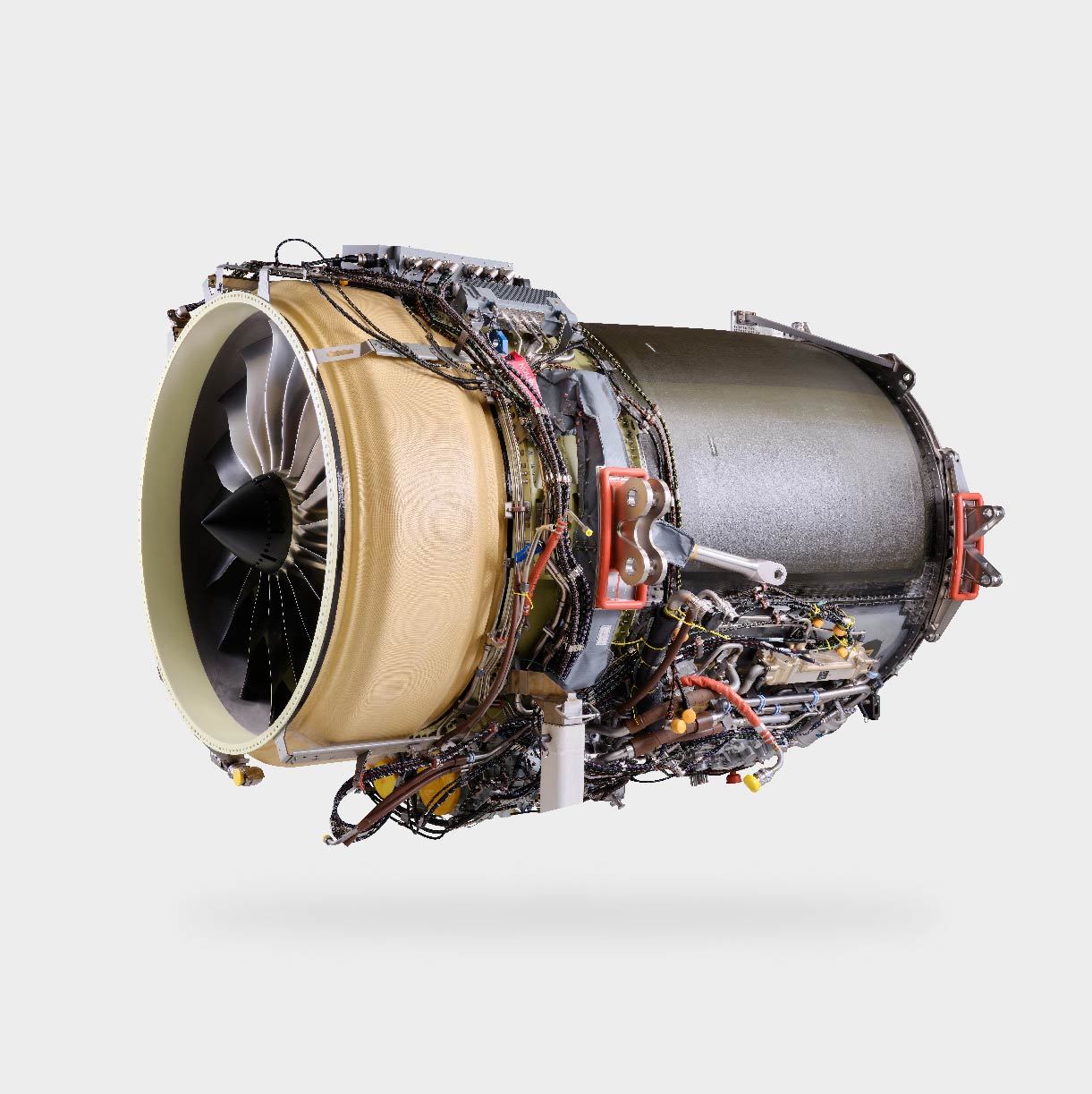
CF34Engine Family
Setting the standard
for reliability in regional
and business aviation
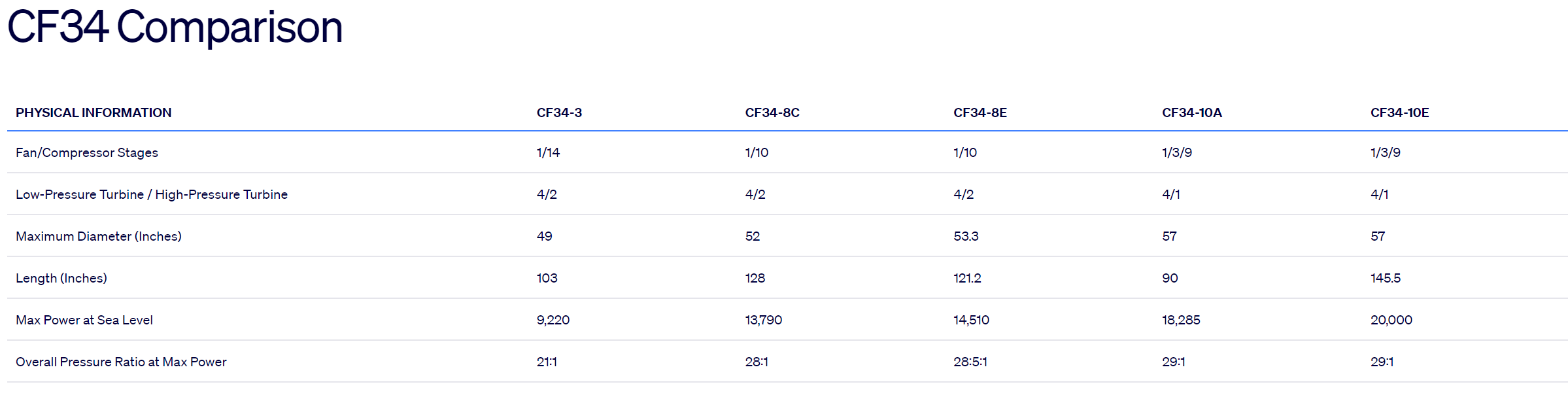
With more than 7,500 CF34 engines powering regional aircraft, this engine family has logged more than 209 million flight hours and 165 million flight cycles. The CF34 has truly set the standard for performance, durability, and world-class reliability.
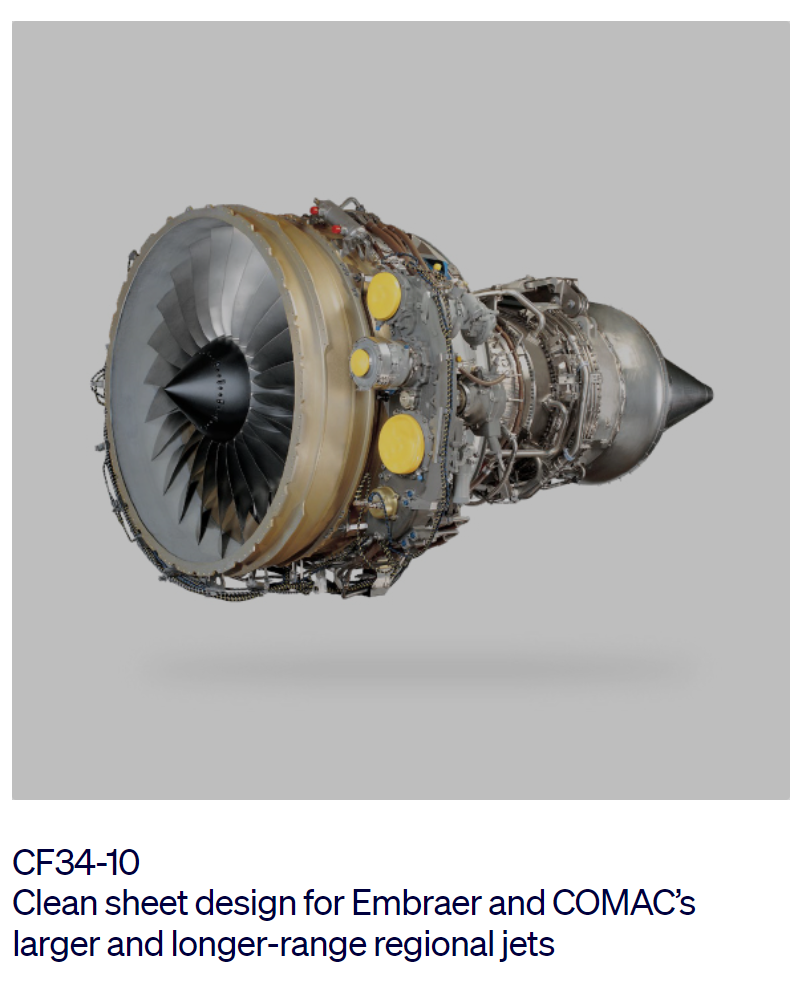
The CF34-10 turbofan
Best-in-class reliability and performance
The CF34-10 engine represents a considerable capability increase over the other CF34 engine models.
- Up to 20,000 pounds of thrust
- Low-risk with proven technology
- Low operating costs through high reliability, ease of maintenance, and best-in-class fuel economy
- The CF34-10E powers both Embraer’s 190/195 and Lineage 1000 aircraft. The CF34-10A powers the COMAC C909 regional jet.
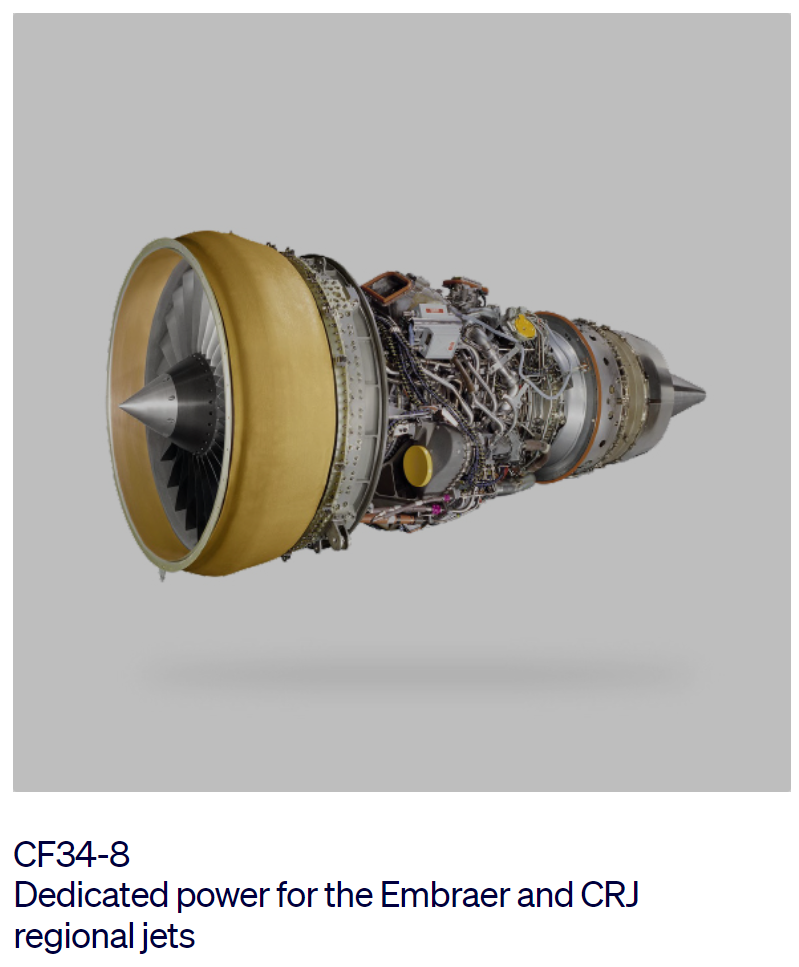
The CF34-8 turbofan
The workhorse of regional aviation
A larger version of the classic CF34-3 engine, the advanced CF34-8 offers:
- A 14,500 lb. thrust class turbofan propulsion system
- 50% more thrust
- Higher thrust-to-weight ratio
- Lower specific fuel consumption
- Reduced number of parts
- Improved maintainability
- The CF34-8E powers the Embraer E170/175 regional jets. The CF34-8C powers the CRJ series of regional jets.
The CF34-8 engine provides the level of reliability and performance that has earned the CF34 family of engines a global reputation for exceptional service.
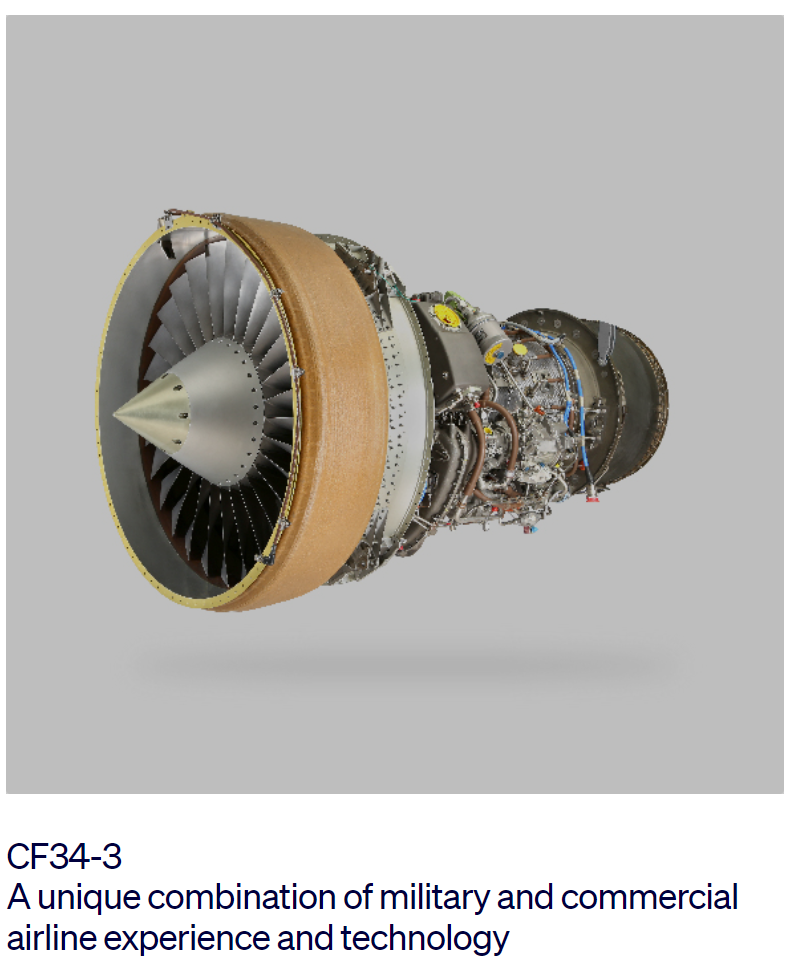
The CF34-3 turbofan
Proven performance and reliability
over four decades
The CF34-3 engine is the sole-sourced engine on the best-selling large business jet platform, Challenger 650 business jet. It also powers the CRJ200 regional airliner.
- 8,729 lbs. of thrust
- 99.99% on-time departure rating
- 61 million cumulative cycles
- In markets where reliability, durability, and time-on-wing matter, the CF34-3 consistently delivers. GE Aerospace’s CF34-3 engine started out in military as the TF34, most famously on the A-10 in the early 1970s. Since its service entry in 1992 on the Challenger 601, the CF34-3 engine has earned an industry-leading reputation as one of the cleanest and most fuel-efficient engines in its class, while being synonymous with reliability.
Frequently Asked Questions
-
What is the typical lead time for gas turbine overhaul services?
The lead time for gas turbine overhaul services ranges from 6 to 14 weeks, depending on the damage assessment, parts availability, and whether hot-section repairs are required. Expedited options may reduce this by 30%.
-
Do you provide customizations for legacy turbine control systems?
Yes, we retrofit legacy systems (e.g., GE Frame 5, Siemens V94.2) with modern digital controllers, typically completing hardware integration within 4-8 weeks. Software migration requires additional validation time.
-
How often should industrial gas turbines undergo performance testing?
We recommend annual performance testing under ISO 3977-2 standards. Critical applications (e.g., offshore platforms) may require semi-annual tests with emissions compliance checks.
-
Are your radiation-hardened (rad-hard) semiconductors compliant with MIL-PRF-38535?
All rad-hard devices (e.g., FPGA, ADC) are QML Class V certified under MIL-PRF-38535 and tested to MIL-STD-883 Method 1019 for SEU tolerance. Full qualification reports are available upon request.
-
What temperature ranges do your military-grade ICs support?
Our ASICs and power management ICs operate across -55°C to +175°C ambient temperatures, with derating curves provided in military temperature range (MTR) datasheets.
-
Are PMA parts interchangeable with OEM components?
Our PMA parts (e.g., actuators, sensors) hold FAA/EASA Form 1 certification and match OEM form/fit/function. Installation requires SB/MB documentation per FAA AC 23.1529.
-
What traceability standards do you follow for aircraft fasteners?
All NAS/MS fasteners include full DNA traceability: melt source (AMS 2301), heat/lot numbers, and AS9100-compliant MTRs with ultrasonic test reports.
-
How do you handle urgent AOG (Aircraft on Ground) requests?
AOG orders ship within 4 hours for stocked items (FAA-PMA, EASA Part 21G). Non-stock critical parts trigger priority manufacturing with 72-hour max turnaround.


 Aircraft parts